
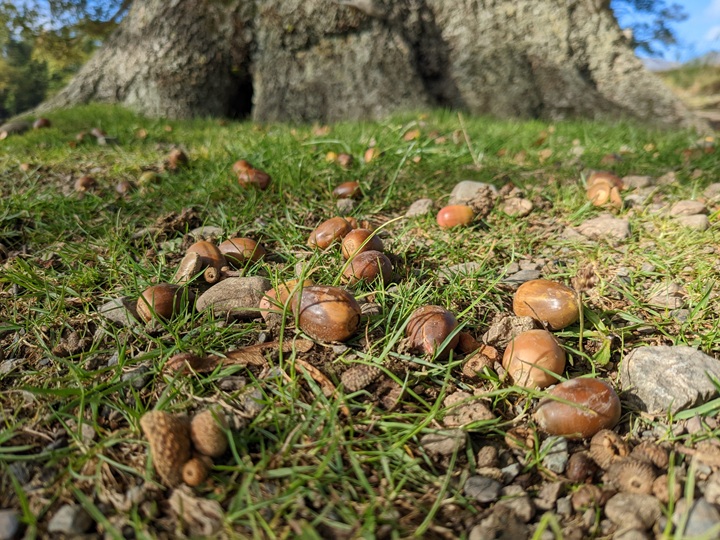
Seeds start forest renewal, allowing forests to regenerate, expand and adapt to changing conditions. But our new study, published in Nature Climate Change, shows that climate change may be weakening tree fecundity in Europe’s trees.
We analysed 34 years of Polish forest seed-harvest records, covering 40,530 annual observations from 438 forest districts between 1988 and 2021. The dataset included five major forest-forming species: European beech, silver fir, Scots pine, pedunculate oak and sessile oak.
These long-term records are particularly valuable because they report sorted seed lots. In other words, they reflect seeds that pass quality control, with empty, damaged or infested seeds largely removed. This means the data provide insight into viable seed production, not just the total number of seeds produced.
The results were striking. Viable seed production declined across all studied taxa: by around 65% in oaks, 64% in Scots pine, 44% in silver fir and 32% in European beech.
One important challenge was that seed harvest records reflect both biological seed availability and ‘human’ demand for seeds. Foresters collect seed when they are needed, and demand for seed also declined over time. To address this, we accounted for seed collection effort in our analyses. Even after doing so, the decline in viable seed production remained, suggesting that the pattern cannot solely be explained by people collecting fewer seeds.
Summer warming emerged as the strongest driver of the decline. Across species, hotter summers were linked to lower viable seed output. Spring temperatures and growing-season moisture also affected reproduction, but they explained less of the long-term decline than summer warming.
We also found that climate effects differed among local populations. A warm or dry year could have different consequences depending on the long-term climate of a site. This points to a possible role for local adaptation or acclimation.
A second line of evidence of fecundity decline came from the MASTREE+ database, an independent open-access dataset of plant reproduction. For the same period and species, we found declines in masting: the boom-and-bust pattern of seed production that many trees rely on to produce viable seeds.
Our findings suggest that climate change is reducing the reproductive capacity of important European forest trees. This has direct implications for forest regeneration and seed supply. If viable seed crops continue to decline, nurseries may face shortages of provenance-appropriate seed, and forests may have less capacity to recover after disturbance.
The next step is to connect these fecundity trends with long-term regeneration data. Are declining seed crops already translating into fewer young trees, or are other ecological processes of greater influence?
Read the paper here:
https://rdcu.be/figE9
Foest J.J., Szymkowiak J., Dyderski M.K., Kelly D., Kunstler G., Jastrzębowski S., Bogdziewicz M. 2026. Forest fecundity declines as climate shifts. Nature Climate Change.