
European beech (Fagus sylvatica) is a keystone tree species in European forests. Its reproduction occurs in episodic, highly synchronized mast years that shape forest regeneration, wildlife populations, and ecosystem functioning.
We are building a long-term collaborative network to monitor the ecology of beech reproduction across its entire range.
What we do
We coordinate a Europe-wide sampling network that tracks seed production of European beech populations using a standardized and lightweight field protocol.
Our overarching goal is to understand the ecology of beech reproduction across Europe, including:
- spatial variation in seed production
- drivers of pollination success and failure
- insect seed predation
- relationships between tree size and reproduction
- how these processes respond to spatial and temporal climate variability
The network was established in 2023. Our aim is to maintain this collaboration long-term.
We welcome new collaborators who can contribute at least one beech population.
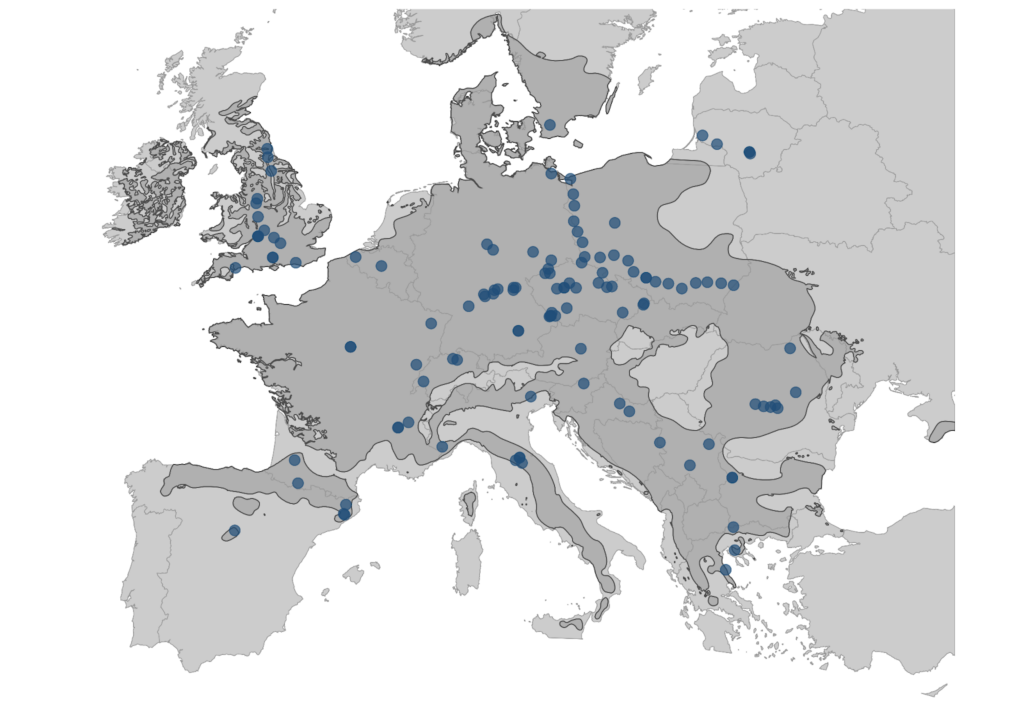
Fig. 1. The map of sites included in the European Beech Reproduction Network as per sampling in 2025.
Why this matters
Reproduction drives forest regeneration
Successful reproduction determines the future of beech forests. Masting seeding underpins:
- forest regeneration and population dynamics
- food availability for wildlife
- seed predator populations and trophic cascades
- long-term forest resilience under climate change
Understanding how reproduction varies across Europe is therefore important for predicting the future of temperate forests.
Climate change is reshaping beech reproduction
Recent work suggests that warming disrupts the reproductive strategy of European beech. In particular, studies have described masting breakdown, where warming reduces interannual variability and synchronisation of seed production, leading to lower pollination efficiency and increased seed predation.
Follow-up work showed that these effects scale with tree size, with larger trees experiencing stronger declines in pollination success.
Why a continental network is needed
So far, most evidence comes from a limited number of regions. We still lack a continental-scale understanding of:
- how reproductive success varies across climates
- whether observed changes are widespread or region-specific
- how climate change is reshaping reproduction across the species range
A coordinated European sampling network is essential to answer these questions.
How to join the network
Our protocol is intentionally simple and low-cost so it can be integrated into existing fieldwork.
What collaborators contribute
Sampling requirements
- At least one beech population
- ~20 trees per population
- Ideally repeated sampling for ≥2 years
Field measurements
For each tree:
- measure tree DBH
- conduct standardized seed collection beneath the tree — it’s only 3.5 minutes
Fieldwork in one population typically takes about 2h.
Logistics
- Seeds are shipped to our lab in Poznań for processing
- We conduct all laboratory work and data analysis
- We provide the full sampling protocol and coordination
- All contributors are co-authors on resulting publications
If you have access to a beech population and would like to contribute, we would be happy to share the protocol and details.
Please, get in touch: michalbogdziewicz@gmail.com
Papers
Network papers
Kondrat et al. – No seed size–number trade-off in European beech: climate governs investment per seed
https://ecoevorxiv.org/repository/view/11746/
Background studies
- Bogdziewicz et al. (2020) Climate warming disrupts mast seeding in European beech, Nature Plants, https://doi.org/10.1038/s41477-020-0592-8
- Bogdziewicz et al. (2023) Reproductive collapse in European beech results from declining pollination efficiency in large trees, Global Change Biology, https://doi.org/10.1111/gcb.16730
- Foest et al. (2024) Widespread breakdown in masting in European beech due to rising summer temperatures, Global Change Biology, https://doi.org/10.1111/gcb.17307
- Foest et al. (2025) No refuge at the edge for European beech as climate warming disproportionately reduces masting at colder margins, Ecology Letters https://doi.org/10.1111/ele.70284